The Closed-Loop State
Mapping the Monetary-Political Axis Controlling Canada

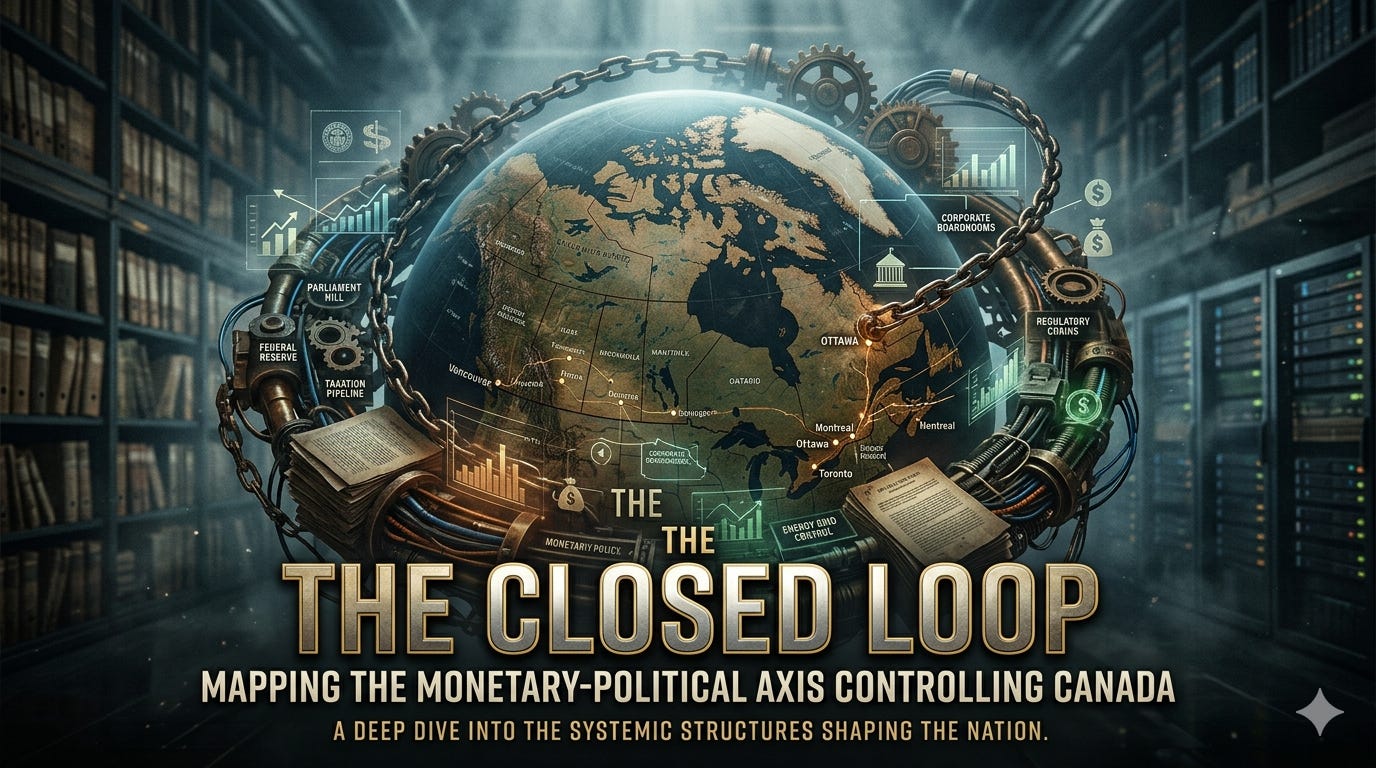
To the casual observer, Canada operates as a standard Western democracy governed by elected officials, checked by an independent central bank, and fueled by a competitive free market.
A granular investigation into corporate registries, pension board allocations, and historical advisory councils reveals a starkly different reality. The Canadian State (constitutionally recognized as The Crown) operates a tightly knit, multi-generational corporatist matrix.
This system operates as a closed loop. A small group of elites cycle between global investment banks, private monopolistic holding companies, public pension boards, and the highest offices of the federal government. Their shared objective is the systematic elimination of financial risk for elite pools of global capital, funded by the socialization of costs domestically, with the resulting profits deployed into state-backed networks in China.
Phase 1: The Ideological Architects (Goldman Sachs & McKinsey)
The matrix does not begin in Ottawa; it begins in the executive boardrooms of Wall Street and global management consultancies. These institutions serve as the intellectual training grounds, shaping the technocrats who treat sovereign nations as corporate balance sheets.
Mark Carney: Before entering federal politics and ascending to Prime Minister, Carney spent 13 years at Goldman Sachs, climbing to Managing Director in investment banking marketscreener.com. His subsequent terms governing both the Bank of Canada and the Bank of England, alongside board positions at Stripe and Bloomberg LP, solidified an ideology: national economies are vehicles optimized through global private credit, corporate consolidation, and state-subsidized “green” investment markets.
Dominic Barton: As the former Global Managing Director of McKinsey & Company, Barton specialized in advising multinational conglomerates on structural scaling. His transition into the Canadian public sphere as the Chair of the federal Advisory Council on Economic Growth provided the direct legislative runway for the corporatist shift.
Phase 2: The Engineered Demand (The Century Initiative)
For corporate monopolies to generate massive, risk-free returns, they require an artificial explosion in domestic demand for real estate, banking services, telecom infrastructure, and utility grids. This demand was intentionally manufactured through an aggressive lobbying framework.
The Blueprint: Co-founded by Dominic Barton and Mark Wiseman (the former Global Head of Active Equities at BlackRock), the Century Initiative successfully lobbied the federal government to alter Canadian demographic policy dominionreview.ca. Their stated goal: aggressively scale Canada’s population to 100 million people by the year 2100 www.centuryinitiative.ca.
The Corporate Incentive: This artificial population surge was not accompanied by a matching public expansion of housing, healthcare, or municipal transit. This created an immediate, compounding resource scarcity. For working citizens, this meant skyrocketing rental costs and suppressed wages due to an oversupply of labor. For the corporate network, it meant an exponential increase in the valuation of their pre-existing financial and real estate assets.
Phase 3: The Private Country Club (The Power Corp Interlock)
To prevent public backlash from disrupting this model, the corporate elite maintain deep, multi-generational, bipartisan control over the federal political apparatus. The absolute epicenter of this political insulation is Power Corporation of Canada, a multi-billion dollar holding giant controlled by the Desmarais family.
Power Corp has historically neutralized political risk by ensuring that the Prime Minister entering office is already deeply connected to their boardroom through literal family bloodlines, direct past paychecks, or foundation funding:
The Bloodline (Jean Chrétien): This is not a passive political friendship; it is a literal family tree. Jean Chrétien’s daughter, France Chrétien, married André Desmarais, the Co-CEO and Deputy Chairman of Power Corp. Chrétien’s chief policy architect and political organizer, John Rae, simultaneously served as the Executive Vice President of Power Corp.
The Paychecks (Brian Mulroney & Paul Martin): Before becoming Prime Minister, Brian Mulroney was a highly paid labor lawyer retained by the Desmarais family; the moment he left office, Power Corp hired him back as a senior board advisor. Paul Martin was employed directly inside Power Corp as a high-level executive, later purchasing Canada Steamship Lines directly from them in a lucrative deal that established his personal fortune.
The Foundations (The Trudeaus): Power Corp executives and Desmarais family members actively sat on the board of directors of the Pierre Elliott Trudeau Foundation, managing and funding the multi-million dollar asset pool honoring the family legacy while Justin Trudeau rose through the political ranks.
The Regulatory Gateway: Power Corp’s board is explicitly engineered for regulatory foresight, featuring independent directors like Paula B. Madoff, a 20-year Goldman Sachs veteran who shares the exact institutional background, ideology, and Wall Street network as Mark Carney powercorporation.com.
Phase 4: The Geopolitical Endpoint (The Beijing Pipeline)
The capital extracted from Canadian consumers does not remain domestic. Power Corp has spent 50 years acting as the primary economic pipeline bridging Canadian governance, elite capital, and the Chinese State.
The Vanguard: In 1978, Paul Desmarais Sr. traveled to Beijing and founded the Canada-China Business Council (CCBC), an elite corporate lobbying entity that continues to guide Canada’s trade policies ccbc.com. André Desmarais (Chrétien’s son-in-law) sat directly on the board of CITIC Pacific, the primary investment arm of the Chinese State, from 1997 to 2014. Power Corp remains one of the largest foreign shareholders in China Asset Management Corp.
The Modern Exposure: This Beijing axis is fully active under the Carney administration. Official disclosures from Brookfield Asset Management (which Carney chaired prior to entering politics) revealed that the fund holds over $3 billion in sensitive investments inside Chinese state-linked infrastructure and real estate marketscreener.com.
The State Bank Debt: During federal committee scrutiny, political opposition exposed that Brookfield owes an active $250 million loan to a Chinese state-controlled bank, creating a direct financial interlock between the Prime Minister’s former corporate home and the Chinese Communist Party. Concurrently, Carney has aggressively pushed policy frameworks to significantly accelerate and expand bilateral trade, stating a goal to double exports to Beijing.
Phase 5: The Public Funding Engine & The Pension Trap (CIB & CPPIB)
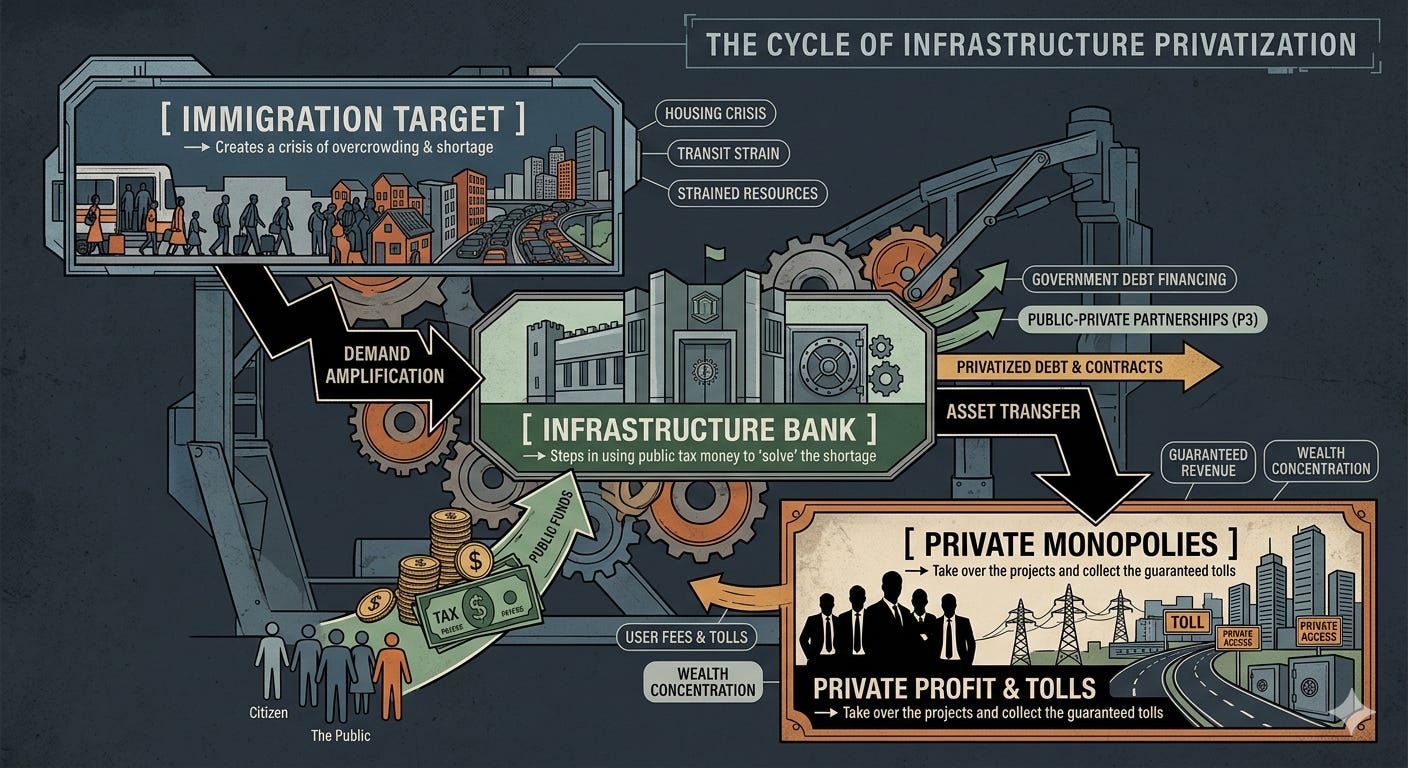
When the artificial population boom triggered a desperate need for national infrastructure, the state claimed public coffers were empty. Rather than funding infrastructure through traditional, low-cost public bonds, the state deployed a mechanism designed to enrich private asset managers.
The Canada Infrastructure Bank (CIB): Freedom of Information disclosures revealed that federal cabinet ministers worked hand-in-hand with BlackRock executives to construct the CIB cupe.ca. Its explicit business model is “socializing the risk, privatizing the profit.” The bank uses public tax dollars to fund the volatile, expensive, upfront construction costs of utility grids, transit corridors, and green energy arrays cupe.ca.
The Private Hand-off: Once a project is fully operational and de-risked, the long-term management and revenue collection are transferred to mega-firms like Brookfield and Power Corp subsidiaries cupe.ca. These private entities extract inflation-protected tolls, user fees, and service premiums directly from Canadian consumers.
The Pension Hostage Situation: This loop is structurally locked down via CPP Investments (CPPIB), which manages over $600 billion of working Canadians’ retirement capital cppinvestments.com. Board members like William “Mark” Evans ensure that public pension money is heavily deployed as foundational capital backing these exact same elite private infrastructure and green transition funds cppinvestments.com. Furthermore, CPPIB annual reports disclose billions of dollars in active holdings within mainland Chinese equities and state-linked markets. Working Canadians are placed in a structural vice: their current tax dollars fund local corporate projects, while their mandatory retirement savings are deployed overseas to stabilize the very state-backed global markets where Power Corp and Brookfield operate cupe.ca.
The Complete Flow of Capital
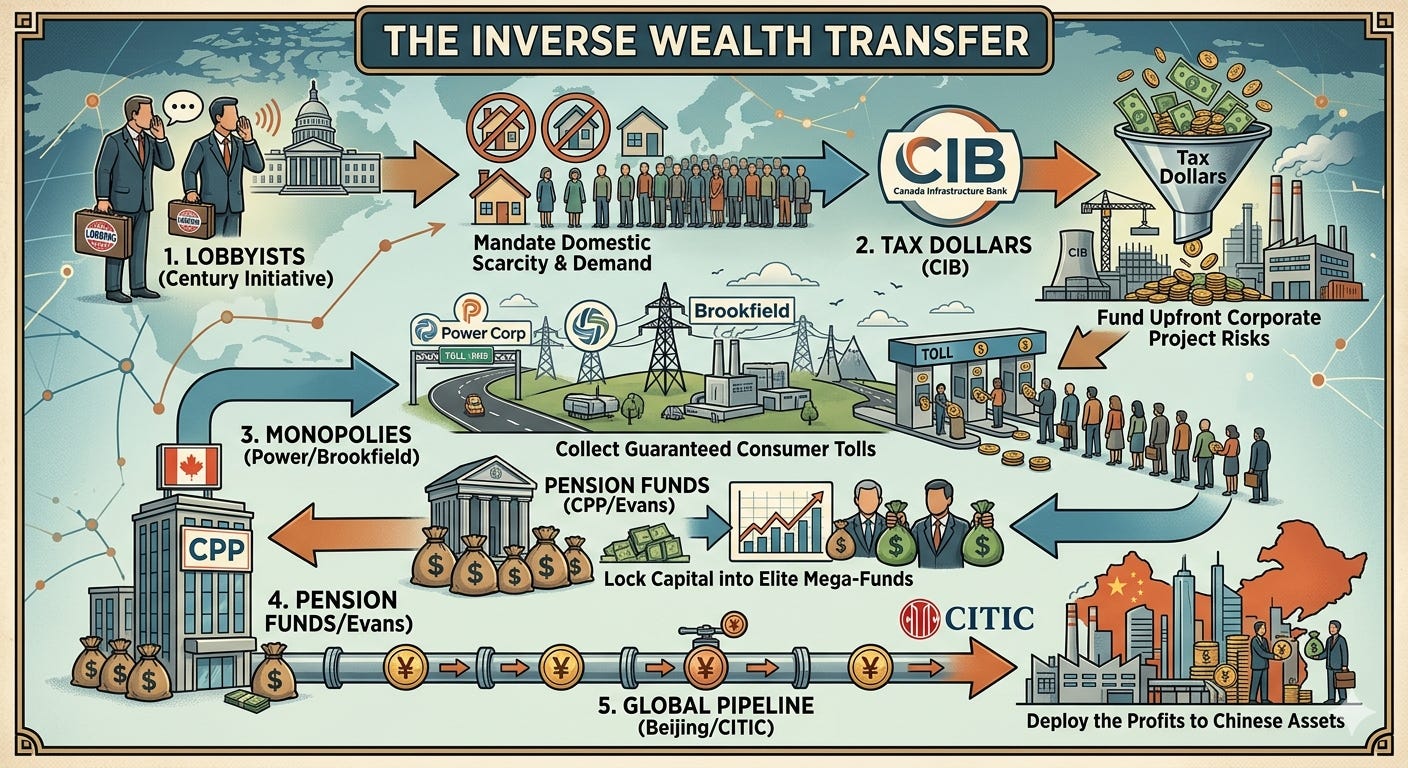
The system operates as a flawless conveyor belt. The Wall Street planners dictate the demographic policy; the federal government uses the power of the State to legislate the resulting infrastructure demand; the public purse absorbs the financial liabilities cupe.ca; the private monopolies pocket the guaranteed consumer revenue; and the final wealth is funneled down the pipeline to fund high-yield assets linked directly to the Chinese State.
Because the public’s pension security is intentionally bound to the financial success of these mega-funds, the State is structurally incapable of breaking up these monopolies cppinvestments.com. The average citizen is caught in an economic vice: forced to pay some of the highest consumer, telecom, insurance, and utility fees in the developed world to private entities, while their own tax dollars and retirement contributions are used to subsidize the very machine stripping away their purchasing power cupe.ca.
If you found value in this deep-dive investigation, please consider sharing it. Independent, source-verified journalism relies entirely on word-of-mouth to bypass mainstream narratives. By sending this to a friend, family member, or colleague, you help break the silence on the corporate-political networks shaping Canada.
Thank you for reading and supporting independent research.
Appendix: Statutory Records and Source Verification Index
1. Corporate Entities and Subsidiary Disclosures
Power Corporation Board of Directors and Corporate Information: Multi-jurisdictional holding company profile detailing the oversight of Great-West Lifeco and IGM Financial [powercorporation.com].
Brookfield Asset Management Market Profile: Financial tracking portal detailing global infrastructure funds, asset control registries, and executive history filings [marketscreener.com].
Canada China Business Council Identity Profile: Encyclopedia entry tracking the 1978 founding, operational mandates, and office networks across Toronto, Beijing, and Shanghai [en.wikipedia.org].
2. Parliamentary and Access to Information (ATIP) References
CUPE Access to Information Briefing: Infrastructure Privatization Records: Public sector research analysis showcasing the unsealed internal Department of Finance memos and coordination with corporate advisors [cupe.ca].
Parliament of Canada Legislation Database: Bill C-44 (2017): Official parliamentary legislative repository tracking the first reading text and statutory execution of the Canada Infrastructure Bank Act under Division 18 [www.parl.ca].
Canada Infrastructure Bank Official Bank Mandate (FAQ): Statutory transparency board explaining CIB financial accountabilities, joint auditor frameworks, and private-public project capital deployment guidelines [cib-bic.ca].
3. Pension Board Oversight
CPP Investments Corporate Board Roster: Official corporate governance directory listing active directors, board strategy metrics, and human resource committees [powercorporation.com].
CPPIB Public Appointment Profile: William ‘Mark’ Evans: Official appointment registry of Mark Evans outlining his 15-year tenure at Goldman Sachs and subsequent deployment to the CPPIB investment engine [cppinvestments.com].
Advisor Canada Industry Report: Federal Pension Nominations: Financial press record verifying the consultation process between the Department of Finance and provincial governments to populate the pension board seats [advisor.ca].
Legal and Professional Disclaimer
This article is prepared strictly for educational, historical, and structural investigative journalism purposes. The information contained herein is gathered entirely from public corporate filings, parliamentary committee transcripts, registered lobbying returns, and verified historical records. This text does not constitute personal financial advice, investment recommendations, or legal counsel. All trademarks, corporate logos, and brand identities referenced belong strictly to their legally registered owners.